Monday, April 5, 2010

Response to Zac's Prepare a meal post

In this post, Zac explains how he prepared a meal for himself. Zac decided to make macaroni and cheese and a couple hot dogs. He states how he bought each item at the grocery store and used the kitchen in his dorm to prepare the meal. He goes on to explain just how he made his macaroni and cheese, by boiling water, putting the noodles in, and draining the noodles after they had been boiled. He clarifies that to finish off making his macaroni and cheese, he added the cheese powder, milk and butter. After finishing the macaroni and cheese, Zac made the hot dogs by cooking them in a pan on the top of the stove.


After spending an hour preparing his meal, Zac finally began eating. He started by eating the macaroni and cheese, followed by consuming the two hot dogs, which included mustard and ketchup. Zac definitely enjoyed his meal. To clean up, he washed the pans and silverware he used in preparation, put away the condiments, and threw away the trash produced. Zac describes how he felt proud after making himself a meal.


Zac agreed with what Pollan had to say after re-reading pages 54-55 of In Defense of Food. He agrees with the fact that eating has become less than what it used to be and admits that the cheese used in his macaroni and cheese was not actually “real” cheese and the hot dogs were definitely processed. I agree with Zac’s opinion regarding Pollan’s reading and believe that he quickly summarized the reading quite well.


In addition to blogging about preparing a meal and summarizing Pollan, Zac included a link to a very helpful site. The site is regarding eating habits and explains how exactly people eat and the eating behaviors that are learned. I think this corresponds with what Zac wrote about because it is reiterating the fact that the way Americans eat has changed overtime and that it differs among individuals. 

Post 5: Prepare a meal

While on spring break, I decided to prepare a very healthy lunch for myself. Before beginning to actually put together my lunch, I had to plan what exactly my meal would be made up of. I wanted to incorporate a variety of nutritious elements. I decided to make a salad consisting of lettuce, mozzarella cheese, carrots, Chow Mein noodles, pecans, croutons, and leftover teriyaki chicken from the previous night’s dinner. The salad would be topped with Italian dressing. On the side, I wanted to cut up a variety of fruit.


After deciding on what I wanted to eat, my preparation took place. To begin, I gathered up all my ingredients. I washed my lettuce and carrots and cut both into bite-size pieces. I put the cut lettuce and carrots on a plate, then added just the right amount of mozzarella cheese, pecans, croutons, and Chow Mein noodles. The next step was heating up the chicken. I cut the chicken breast into thin strips and then heated the strips up. After warming up the chicken, I added that to the salad and poured some Italian dressing on top. Now that my salad was complete, I had to gather, wash, and cut up my fruit. I grabbed pineapple, strawberries, and grapes as my fruit of choice. I washed each fruit under cold water, and then moved on to cutting each up. The pineapple was cut into small bite-size pieces, the strawberries were cut in half, and the grapes were left alone! I decided to clean up my ingredients before eating so that I wouldn’t have to worry about it after eating. I just put everything away and wiped down my area I worked in.


After preparing my healthy lunch, it was finally time to eat! I really enjoyed eating my chicken salad and fruit, and each element tasted great. I felt content after eating this meal because I felt as though I prepared a healthy yet delicious meal in less than 15 minutes.


After reading Pollan’s section of In Defense of Food regarding the fact that the American culture has led to acceptance of “a flood of damaging innovations…such as low-fat processed food,” definitely seems true in my eyes. Harvey Levenstein, a well-known author, describes how our culture now has a tendency to “eat and run” rather than “dine and savor.” Because of this, Americans aren’t taking the time to prepare well-balanced meals. This statement definitely is true because I feel as though many families and college students don’t take the time to sit down and enjoy a healthy meal; rather, they are constantly rushing to put together whatever is convenient to them. Because I am a college student, I tend to fall into this category, but while home for spring break, I decided to actually make something good to eat for once. This particular article proves that college students do not eat as healthy as one should. My goal is to continue to prepare healthy meals while at college.

Saturday, March 27, 2010

Response to Ivan's celebrity endorsement post

In this post, Ivan analyzes Tony Stewart’s celebrity endorsement with Burger King. Stewart is a NASCAR driver and has recently begun to promote Burger King. Ivan begins his blog by presenting a commercial in which Tony Stewart is teaching a class of other celebrities the proper way to endorse a product. He makes sure the class understands that you should endorse what you believe in. Stewart admits to loving the Whopper from Burger King, and that this is his reason for endorsing it.

Ivan explains how Burger King believes that the reason why Tony Stewart endorses their product is because he believes in it, is comfortable with it, and loves it. The fact that the only way to endorse Burger King is having a celebrity who can claim his devotion to the product and explain how it can satisfy his hunger. 

To conclude his blog, Ivan presents the fact that the endorsement with Tony Stewart has mutual benefits. For Burger King, additional publicity is formed due to the fact that Stewart promotes the Burger King logo on his NASCAR uniform and presents to the public his love for the Whopper. For Tony Stewart, endorsing Burger King has made him richer. Ivan includes an article regarding the multi-year contract Steward has signed with Burger King. Putting an article like this in the blog was definitely helpful as a reader to fully understand Stewart’s endorsement deal with Burger King and how it affects Stewart as well as Burger King.

I agree with what Ivan proposes in this blog. I believe Tony Stewart is a legitimate celebrity endorser for Burger King because he believes and loves the product. I think that the ideas and opinions presented in this blog are clear and convincing and are easy to follow with facts backing up his beliefs. 

Post 4: Compare two online articles

Underage drinking is a major issue in the United States. It has been a controversy ever since the drinking age was changed from eighteen to twenty-one in the 1980s. Many individuals throughout America are in favor of this change while a majority of the population opposes this change and wishes for the drinking age to be lowered back to eighteen. Both sides have a variety of valid reasons for taking one side or another. I researched and found two opposing online articles regarding this topic, both having many respectable points in favor of each stance.

The first article, “Do Not Lower the Drinking Age,” discusses reasons why the drinking age should not be lowered back to eighteen. It poses a variety of arguments with responses. In addition to posing certain arguments, it presents four main points with facts to back each up. The first point made is that lowering the drinking age will not reduce the attraction of alcohol for minors. If eighteen year-olds were allowed to drink alcohol, they would be modeling drinking for their younger peers as well as providing easier access to alcohol for minors.  Changing the drinking age to twenty-one is said to have actually decreased the number of youth’s alcohol consumption, and this article has statistics to back this statement up. The article goes onto say that lowering the drinking age does not increase responsibility and even though turning eighteen comes with many privileges such as voting, enlisting in the military, and even smoking; drinking should still not be allowed. The article says that even though many people believe that the law doesn’t work and underage teens drink illegally, the number of young people drinking has actually decreased.

The second article, “The Minimal Drinking Age Should Be Lowered,” presents convincing reasons why the drinking age should be changed back to eighteen. The first point made is that if one is old enough to enlist in the army at the age of eighteen, one should be able to consume alcohol. If an individual can put his or her life on the line, then they should be responsible for all of their actions. Another point made is that many minors drink alcohol despite the law. The article says that even though statistics show that the intake of alcohol in minors has decreased, those who choose to drink are drinking an excess amount. The fact that Europeans drink alcohol at younger ages and the advantages of this is brought up in this article. Growing up with alcohol reduces the dangerous intoxication incidences that seem to be frequently present in the United States. This is one point that I absolutely agree with and almost convinces me alone that the drinking age should be changed back to eighteen. The article also touches on how our education system incorporates classes regarding responsible drinking and the fact that our brain is still developing into our twenties, so whether the drinking age is eighteen or twenty-one doesn’t change the fact that it can still effect brain functions.

I think the second article, which is in favor of changing the drinking age back to eighteen, is more convincing. I believe this because the statistics posed and the facts presented seem to outweigh the responses from the first article. Each point made in the second article counters the arguments states in the first article and seem more valid and reasonable. After analyzing these articles, my opinion that the drinking age should be changed back to eighteen has stayed the same. I believe it should be changed back. The points that convince me the most are the laws in European countries and how much responsibility one is given when they turn eighteen besides being able to drink. Lowering the drinking age to eighteen would result in positive effects in American in my eyes.

Friday, March 19, 2010

Demonstration Speech Self-Evaluation

I think my demonstration speech went pretty well. I feel I did a pretty good job physically presenting my topic. I tried to be enthusiastic and energetic, but feel like I could improve on this for my next speech. I believe I spoke loud enough for everyone to hear and stood at a position in the front of the room so that everyone could clearly see my presentation and me. I think I used my visual aids in an effective way and made sure to show each part of my bone stimulator to the class. Usually, I tend to be a little nervous when speaking in front of a group of people. When I get nervous I begin speaking quicker, which makes it difficult for my audience to fully understand my message. Today, however, I believe I did a pretty good job speaking at a slow and steady pace. It is very important to keep eye contact with one’s audience while speaking in front of a group. I think for the most part I kept my eyes on my audience, but I feel as though I could have improved in this area by looking at my entire audience.

Throughout my speech, I believe I did well in trying to connect with my audience through incorporating them in my introduction. I also think I did a good job explaining my topic and its relevance to each individual in the class. I feel that the organization of my speech was well done and you could easily identify the five steps of how to use a bone stimulator.

I am very happy with my demonstration speech today and hope to improve my speaking skills for my next speech, especially focusing on constant eye contact with my audience and enthusiasm while speaking. 

Wednesday, March 17, 2010

Post 3: "Real" vs. "fake" food

As a child, my mom always told me I needed to eat more fruit. She constantly made sure I was having an adequate amount of fruit on my plate every meal. It was easy consuming this "real" fruit growing up because my parents paid for it, I had it prepared for me, and I was almost forced to eat it. Now, being a college student, my eating habits have definitely changed due to three main factors: cost, convenience, and lack of time.


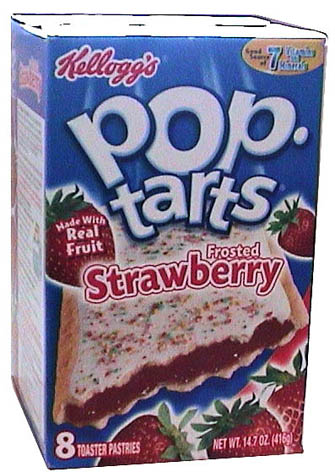
As a college student, I find myself being forced to consume "fake" food. "Real" food costs a good amount more than "fake" good, and living on a college budget, I try saving my money by purchasing processed foods that are lower in cost. Living in the dorms, finding a grocery store to buy fresh "real" fruit is very inconvenient to me especially because for the past four and a half months I have been getting around on crutches. I also find myself short on time, and even to attempt to make it to a grocery store would be a struggle because I am an athlete and it is already hard balancing school and practice every day. For these three reasons, I have gone from eating fresh fruit to eating "fake" foods like pop tarts.


Pop tarts are said to contain real fruit. This fact is somewhat true, but not really. Pop tarts only contain about ten percent fruit. An article from the Washington Post titled, "Is That Right? Pop-Tarts are Made with Real Fruit?" explains why many individuals are mislead as to pop tarts containing a filling made up of "real" fruit. I agree with the content in this article mainly because I was one of those individuals who were mislead, and once I found out just what ingredients pop tarts contained, I wanted to cut back on my intake. Pop tarts look almost like a pastry, which is very pleasing to the eye. They taste much more sugary than regular fresh fruits and smell sweeter as well. I really enjoy eating pop tarts, but wouldn't choose to eat them on a daily basis anymore considering how bad they really are. This "fake" food doesn't provide you with the essential vitamins and nutrients that "real" fresh fruit contain and is not equivalent to eating real fruit. Pop tarts used to claim to be made with real fruit, but no longer go by this motto because of the false information it gave off.


After I am done with college and can afford to buy "real" food again, I will definitely be switching back to buying more fresh fruit. "Real" fruit is one hundred times better for you and is more refreshing than eating a pastry-like pop tart. When I am financially stable, living on my own, and have more time on my hands, I know for a fact I will return to eating the "real" version of fruit.

Peer Response to Mark's Blog Post 2

In this post, Mark discusses an issue regarding "real" versus "fake" food. He begins this blog by capturing his audience's attention by listening specific fruits he ate as a child growing up. After stating this personal information, he starts to explain Michael Pollan's theory on the Western Diet and how it affects many Americans' health. The article Mark attaches does a good job clarifying just how the Western Diet affects individuals' health and how it can cause heart attacks. Mark clarifies that his mother always had fresh fruit at home to eat on a daily basis. He admits that when he was a child he believed eating this fruit was just a simple treat, but now realizes his mom had a purpose for having fresh fruit in the kitchen. I agree with this statement because I feel the same way about my childhood. My parents always made sure I had my daily intake of fruit. I believed it was just refreshing and tasty, but in reality, my parents just wanted me to start eating healthy and get the right nutrition early on in my life.

Mark tells his readers that as he grew up he ran into the issues of cost, laziness, and timeliness. He explains that these issues affected what he chose to eat and how the issues related to the purchase of processed fruit. Mark says that he consumed his first "fake" cup of fruit in high school due to these issues. The "fake" fruit definitely smelled different to Mark, as well as the fact that it seemed more sugary, which made it taste sweeter than the fresh fruit he had consumed as a child. The positive aspects of eating this "fake" food is that there was no mess, your teeth wouldn't hurt if you happened to hit a pit, and there was no skin on the fruit. I also agree with the fact that "fake" foods can have many positives even though nutritionally they aren't as good for you.

To conclude, Mark states that "real" food is certainly the way to go because it is healthier and contains more nutrients. For now, Mark consumes "fake" food because he experiences the issues of cost and timeliness, being a college student. After college, he intends to switch back to "real" food. I have run into the same problems being a college student and will absolutely return to eating "real" food once I live on my own, am financially set, and have a little more time on my hands. Mark did a great job with his ideas. His thoughts were clear and concise and I really agreed with everything he had to say.

Monday, March 1, 2010

Peer Response to Kirby's Blog Post 1

Kirby begins her blog by capturing the audience's attention in introducing Michael Pollan's novel, "In Defense of Food." After introducing the title of the novel, she describes what the first section of the novel is made up of by touching on how he starts the book off with the quote, "Eat food. Not too much. Mostly plants." Kirby then goes into explaining what Pollan believes regarding this topic. Pollan thinks that Americans need to start thinking about what we are putting into our bodies and connects to his readers through stories about his own childhood. He also touches on what the Western Diet is as well as what "nutritionism" is.

Kirby continues blogging about what exactly "nutritionism" is and what it means to Americans. She explains that she agrees with the fact that Americans are worrying too much about nutrients in the foods we eat and how foods are being processed to get the most for our money. I also agree with this statement. I believe that just adding synthesized nutrients to the foods we eat does not make it healthy. Kirby posts a link to a site that focuses on nutritionism and how it is ruining the diets of many Americans. I think this is a great site to incorporate into this particular blog because it goes into detail on a topic she covers in her blog. It helps the reader get a further understanding of nutritionism so that they too can come up with their own opinion on the topic.

To conclude her blog post, Kirby talks about the difference between margarine and butter and Pollan's view on this topic. After directly quoting information from the novel, Kirby adds a little spice of her own. She describes how she was raised on butter. Margarine, in her eyes, is seen as overrated and butter just tastes better. Again, I agree with this statement. It must be a Wisconsin thing, but I was also raised on butter and believe it tastes better than margarine.

Overall, I really enjoyed reading Kirby's blog and agree with everything she had to say. I believe the arguments are clear and her opinions and ideas are very convincing. She does an excellent job introducing a topic and then giving her own personal opinions and ideas regarding the topics. Kirby's sentence structure flowed very nicely and the information presented kept my attention throughout the entire blog!

Wednesday, February 24, 2010

Post 2: Analysis of a Celebrity Endorsement

Many Americans know the infamous Sarah Jessica Parker from her hit T.V. show, Sex and the City. In addition to being a well-known actress, she also works in a variety of advertising campaigns, one being Gap. Gap is an American clothing and accessory brand based in San Francisco, California. It is currently one of the largest specialty apparel retailers in the United States. The following are all the Gap brand stores: Gap, Gap Outlet, GapKids, babyGap, GapBody, and GapMaturnity. The company clearly strives to meet the population as a whole. In my eyes, Gap gives off the image of classy, casual, and fun, which are three characteristics that Sarah Jessica Parker definitely portrays.

Sarah Jessica Parker, in my opinion, is an appropriate choice for Gap's advertising campaign. It is obvious, through her acting, that she is an extremely bubbly, fun-loving, yet still a sophisticated individual. These are the characteristics I believe Gap is trying to strive towards. On Sex and the City, Sarah Jessica Parker is very fashionable. She is seen wearing elegant as well as casual clothing, and Gap absolutely manufactures clothing for every occasion.

The endorsement has been very successful for both Sarah Jessica Parker and Gap. Sarah Jessica Parker has been campaigning with Gap for quite some time now, and from the looks of it, Gap has been satisfied with her work. Many individuals look up to Sarah Jessica Parker, and when they observe her Gap advertisements, it ultimately convinces them to buy the same types of clothing items. In an Entertainment Weekly article titled, "Casual 'Sex'," Gary Muto, president of Gap, is quoted saying, "Gap has always been about individual style, and no one represents this philosophy better than Sarah Jessica Parker." I personally agree with this statement because Sarah Jessica Parker is an individualist and can definitely pull off wearing jeans and a T-shirt or couture. This endorsement deal has been successful for Gap because they are making profit from more Americans, while it has been successful for Sarah Jessica Parker because obviously she is making money and enjoying her job.

Monday, February 15, 2010

Post 1: Response to In Defense of Food by Michael Pollan


Michael Pollan, author of In Defense of Food, begins to propose ideas as to what we should really be putting into our bodies. He starts by trying to connect with his readers on a personal level through his own opinions. In the introduction, Pollan touches on the "Western Diet," informing readers this is a reason that many Americans are overweight. The first section of the novel goes on to explain more about the history of nutrients and why nutrients are so significant for a healthy body. Pollan clarifies what nutritionism is and how particular foods we see in the supermarket today are being replaced. The first section of In Defense of Food starts to offer alternate ways of eating through stating various facts about what and how most Americans eat.

Pollan makes clear the difference between nutrition and nutritionism in the first section of his novel. He states in regards to nutritionism, "the key to understanding food is indeed the nutrient. Put another way: Foods are essentially the sum of their nutrient parts" (28). I definitely agree with this statement and believe that many individuals don't take the time to actually think about what they are putting into their bodies. The goal of nutritionism is that the point of eating should be to promote and maintain your health. I believe it is very important to watch what you eat and try to eat those foods that make you a healthier person.

Another point covered in the first section of In Defense of Food has to do with certain foods being replaced in the supermarket. Pollan gives the example of margarine replacing butter. He explains that margarine is butter with the bad nutrients removed and good nutrients added. Experts comment on this particular site and here the experts actually compare butter and margarine and provide facts regarding both products. When thinking about many of the foods one sees today at the supermarket, other examples of these "fake" foods come to mind and i agree with what Pollan has stated regarding the replacement of foods nowadays.